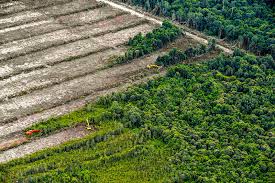
Deforestation

Image result for deforestation
Borneo Island

Deforestation is the action of clearing a large area of trees. It represents one of the largest issues in global land use. Estimates of deforestation are based on the area of forest cleared for human use, including removal of the trees for wood products and for croplands and grazing lands. In the practice of clear-cutting, all the trees are removed from the land, which completely destroys the forest. In some cases, however, even partial logging and accidental fires thin out the trees enough to change the forest structure dramatically.

Deforestation causes can be direct or indirect. Direct causes include natural disasters, such as hurricanes and fires and human activities such as timber extraction and agricultural expansion. Indirect causes include insufficient political actions such as inadequate land tenure system as well as political and social economic causes as population growth, military conflicts and climate change.

Livestock farming and culivations are massive causes of deforestation. The impact is higher than many people realise as after trees are extracted for commercial timber works the remaining forest area are set on fire which majorly impacts local plants and animals. The subsitution of forest areas for farming is then complete with no action taken to reduce or balance the carbon created and life lost.

Hundred year old trees are often cut down to make timber or cellulose for large industries such as furniture or paper production. No matter how the wood is cut it is still damaging to the environment and the damages are increased by roads being created for vehicles to transport the timber to its next destination. Because of this other economically unattractive trees are cut down despite their biological and ecological value.

Firewood collection and road construction are other major causes of deforestation. Firewood collecting is usually done by native populations who need it as means of survival due to their recent population growth. In reference to road construction, dam construction and industrially exploited mines also cause massive deforestation.

A major affect of deforestation is loss of habitat, and then in turn loss of animal and plant species. This is a major issue as we lose species we know and also some that we never got the chance to investigate and record. Seventy percent of the Earth’s land animals and plants live in forests such as the Amazon, and many cannot survive the deforestation that destroys their homes as they are given no time for adaptation and thus evolution of their species. The trees in these rainforests also provide shelter for some species while regulating the temperature of the forests which is a necessity to many animals. The removal of the animal’s temperature regulator would cause desert like conditions with a large temperature variation from day to night which is fatal to many of the rainforest’s current inhabitants.

As well as the loss of habitat, deforestation also lets larger amounts of greenhouses gases enter the atmosphere. Currently rainforests in South America are responsible for 20% of Earth’s oxygen and they are disappearing at a rate of four hectares in a decade. If these rates are not stopped and turned back around the consequences for our Earth are unimaginable.
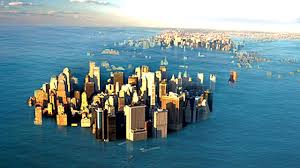
Rising Sea Levels

Image result for water levels rising
An image of what the average city will look like if water levels keep increasing

The official definition of rising sea levels is:

Definition of Sea Level Rise:The term sea-level rise generally designates the average long-term global rise of the ocean surface measured from the centre of the earth (or more precisely, from the earth reference ellipsoid), as derived from satellite observations. Relative sea-level rise refers to long-term average sea-level rise relative to the local land level, as derived from coastal tide gauges.

The world’s seas have absorbed more than 90% of the heat from greenhouse gases and fossil fuels. Average sea levels have swelled over 23cm since 1880, with about 8cm of that occuring in the last 25 years. Every year the sea rises another 3.2mm.

Three major factors of rising sea levels that are induced by climate change are thermal expansion, melting glaciers and loss of Greenland and Antarctica’s ice sheets.

Thermal expansion is the cause of 50% of sea level rise over the last 25 years as the heat being absorbed by the ocean is causing the water to heat up and expand thus increasing the ocean’s mass and therefore level.

Melting glaciers are another major way in which climate change has caused the rising sea levels. Large ice formations naturally melt slightly over the course of hot summer months, during the winter snow from evaporated seawater are generally able to stop further melting. However in recent times summer time melting has increased drastically and snowfall has decreased due to later winters and earlier springs. This in turn causes an imbalance between surface run off and ocean evaporation which causes sea levels to then rise.

Similarly to melting glaciers, higher temperatures are causing the large ice sheets covering Greenland and and Antarctica to melt faster. Scientists are also suspecting that the Greenland’s ice sheets are moving more quickly into seas due to the melt water from above ground and seawater from below lubricating the ice streams. Melting in West Antarctica has been a major cause for concern among scientists, especially after a break occurred in the world’s most major ice shelf (the Larsen C shelf) in 2017. 3 years on, glaciers in East Antarctica are also showing signs of destabilisation.

The effect of this is the negative impact on coastal habitats such as destructive erosion, wetland flooding, agricultural land poisoning and loss of habitat for animals and plants alike. These high sea levels are also causing more dangerous hurricanes and typhoons that move slower but are more powerful. This in turn causes more powerful storm surges that in turn have accounted for nearly half of all death by Atlantic hurricanes from 1963 and 2012. Low lying coastal areas are in threat causing their inhabitants to migrate to higher ground as they are otherwise vulnerable to floods as well as threats to their services such as internet and communications technologies.

The most recent report from a climate change panel says to expect ocean rise to be between 26 to 77 centimetres by 2100 with temperatures rising by 1.5 degrees Celsius. This is enough to seriously flood many cities along eastern USA and possibly make low lying cities uninhabitable. NASA and European data are predicting the higher end of the spectrum with their prediction being a 65cm rise by the end of the century.

Unfortunately the rising sea levels are now unavoidable but their affect can be minimised by reducing the greenhouse gases in the atmosphere and reducing climate change as best we can.

Forest Fires

Image result for amazon fires
Amazonian Fires

Forest fires were occuring in the Amazon for weeks before the world started to notice. These fires were at their peak in August with approximately 30,000 fires at any one time.

There were many causes for this. Forest fires often occur in the amazon during dry seasons, mainly July and October. This is because the wood becomes so dry and hot that it can catch alight. Other natural causes of these fires are events like lightening strikes on a group of trees. While all these events are commonplace, never before have these fires met these extremities.

This year however the vast majority of the fires are thought to have been started by farmers and loggers clearing land for crops, grazing and their own personal economic expansion.

The reason that this is so serious is because the Amazon is the world’s largest rainforest and is an essential carbon sink that helps us to slow down the rate of global warming and climate change. This matters because the Amazon is the largest rainforest in the world and a vital carbon store that slows down the pace of global warming.

In late August the president of Brazil deployed the army to the amazon and ordered a 60 day ban on stopping fires

Two months on from the hype about the fires it is presumed by all that the fires in the Amazon have stopped. However this is not the case, the only difference between the months is that the media coverage has stopped. The 60 day ban on fires issued by the government has long since ended and the fires are still occuring at above average rates.

Fires are also occurring outside the Amazon and are not receiving any media coverage. The Cerrado Savannah is ‘one of the most endangered ecosystems on the planet.’ There were more fires there than in the Amazon last month. The Cerrado is one of the world’s most biodiverse areas in the world. 40% of plant and animal species can’t be found anywhere else on the planet with populations of jaguars and macaws. According to new research about half of the Cerrado has already been lost, mainly to make way for soy bean farming.

All this shows how forest fires are a serious and terminal issue in our world today and must be remedied immediately. We must all put pressure on the media to report these problems and to put pressure on governments to act and on people to donate and to make a change. That is the only way this problem can be fixed.

Create your own website, free on WordPress.com.Create your own website.
Start free