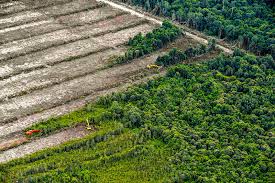
Deforestation is the action of clearing a large area of trees. It represents one of the largest issues in global land use. Estimates of deforestation are based on the area of forest cleared for human use, including removal of the trees for wood products and for croplands and grazing lands. In the practice of clear-cutting, all the trees are removed from the land, which completely destroys the forest. In some cases, however, even partial logging and accidental fires thin out the trees enough to change the forest structure dramatically.
Deforestation causes can be direct or indirect. Direct causes include natural disasters, such as hurricanes and fires and human activities such as timber extraction and agricultural expansion. Indirect causes include insufficient political actions such as inadequate land tenure system as well as political and social economic causes as population growth, military conflicts and climate change.
Livestock farming and culivations are massive causes of deforestation. The impact is higher than many people realise as after trees are extracted for commercial timber works the remaining forest area are set on fire which majorly impacts local plants and animals. The subsitution of forest areas for farming is then complete with no action taken to reduce or balance the carbon created and life lost.
Hundred year old trees are often cut down to make timber or cellulose for large industries such as furniture or paper production. No matter how the wood is cut it is still damaging to the environment and the damages are increased by roads being created for vehicles to transport the timber to its next destination. Because of this other economically unattractive trees are cut down despite their biological and ecological value.
Firewood collection and road construction are other major causes of deforestation. Firewood collecting is usually done by native populations who need it as means of survival due to their recent population growth. In reference to road construction, dam construction and industrially exploited mines also cause massive deforestation.
A major affect of deforestation is loss of habitat, and then in turn loss of animal and plant species. This is a major issue as we lose species we know and also some that we never got the chance to investigate and record. Seventy percent of the Earth’s land animals and plants live in forests such as the Amazon, and many cannot survive the deforestation that destroys their homes as they are given no time for adaptation and thus evolution of their species. The trees in these rainforests also provide shelter for some species while regulating the temperature of the forests which is a necessity to many animals. The removal of the animal’s temperature regulator would cause desert like conditions with a large temperature variation from day to night which is fatal to many of the rainforest’s current inhabitants.
As well as the loss of habitat, deforestation also lets larger amounts of greenhouses gases enter the atmosphere. Currently rainforests in South America are responsible for 20% of Earth’s oxygen and they are disappearing at a rate of four hectares in a decade. If these rates are not stopped and turned back around the consequences for our Earth are unimaginable.
 Aoibheann's Geography Blog