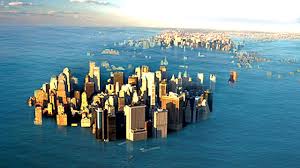
The official definition of rising sea levels is:
| Definition of Sea Level Rise:The term sea-level rise generally designates the average long-term global rise of the ocean surface measured from the centre of the earth (or more precisely, from the earth reference ellipsoid), as derived from satellite observations. Relative sea-level rise refers to long-term average sea-level rise relative to the local land level, as derived from coastal tide gauges. |
The world’s seas have absorbed more than 90% of the heat from greenhouse gases and fossil fuels. Average sea levels have swelled over 23cm since 1880, with about 8cm of that occuring in the last 25 years. Every year the sea rises another 3.2mm.
Three major factors of rising sea levels that are induced by climate change are thermal expansion, melting glaciers and loss of Greenland and Antarctica’s ice sheets.
Thermal expansion is the cause of 50% of sea level rise over the last 25 years as the heat being absorbed by the ocean is causing the water to heat up and expand thus increasing the ocean’s mass and therefore level.
Melting glaciers are another major way in which climate change has caused the rising sea levels. Large ice formations naturally melt slightly over the course of hot summer months, during the winter snow from evaporated seawater are generally able to stop further melting. However in recent times summer time melting has increased drastically and snowfall has decreased due to later winters and earlier springs. This in turn causes an imbalance between surface run off and ocean evaporation which causes sea levels to then rise.
Similarly to melting glaciers, higher temperatures are causing the large ice sheets covering Greenland and and Antarctica to melt faster. Scientists are also suspecting that the Greenland’s ice sheets are moving more quickly into seas due to the melt water from above ground and seawater from below lubricating the ice streams. Melting in West Antarctica has been a major cause for concern among scientists, especially after a break occurred in the world’s most major ice shelf (the Larsen C shelf) in 2017. 3 years on, glaciers in East Antarctica are also showing signs of destabilisation.
The effect of this is the negative impact on coastal habitats such as destructive erosion, wetland flooding, agricultural land poisoning and loss of habitat for animals and plants alike. These high sea levels are also causing more dangerous hurricanes and typhoons that move slower but are more powerful. This in turn causes more powerful storm surges that in turn have accounted for nearly half of all death by Atlantic hurricanes from 1963 and 2012. Low lying coastal areas are in threat causing their inhabitants to migrate to higher ground as they are otherwise vulnerable to floods as well as threats to their services such as internet and communications technologies.
The most recent report from a climate change panel says to expect ocean rise to be between 26 to 77 centimetres by 2100 with temperatures rising by 1.5 degrees Celsius. This is enough to seriously flood many cities along eastern USA and possibly make low lying cities uninhabitable. NASA and European data are predicting the higher end of the spectrum with their prediction being a 65cm rise by the end of the century.
Unfortunately the rising sea levels are now unavoidable but their affect can be minimised by reducing the greenhouse gases in the atmosphere and reducing climate change as best we can.
 Aoibheann's Geography Blog